Start Your Book Printing Project
Share a few details about your book. JetPrint will review your specifications and help you identify the suitable printing, paper, binding, and finishing options for your project.


Margins look harmless.
But once a novel grows from 250 pages to 450, 600, or 750 pages, the relationship between the text block, paper caliper, spine, adhesive, trim size, and opening angle changes enough that a layout looking perfectly comfortable on a monitor can become irritatingly tight after the physical book is bound.
Why discover that after thousands of copies have already been printed?
I consider the gutter one of the most underestimated variables in book interior formatting.
Designers often ask for a universal number: 0.5 inch? 0.625 inch? 0.75 inch?
That question is understandable.
It is also incomplete.
The correct book gutter margins depend on how thick the finished book becomes and how much of the inner page remains comfortably visible when a reader opens it. Page count matters, but so do paper thickness, binding construction, trim width, spine flexibility, and even how aggressively the reader is expected to open the book.
For publishers preparing a long work through a professional novel printing service, I would settle the binding and paper specification before treating the interior margins as final.
First, terminology.
A margin is the space between the text area and the physical edge of the page. On facing pages, we normally describe four working zones:
“Gutter” creates confusion because different applications use the term differently.
Amazon KDP describes the inside margin itself as the gutter. Microsoft Word, meanwhile, may provide both an inside margin and a separate gutter field. Adobe InDesign normally encourages designers to work with Inside and Outside margins when Facing Pages is enabled.
That naming difference causes real file errors.
A designer may specify a 0.625-inch inside margin and then add another 0.25-inch software gutter, unintentionally producing an enormous 0.875-inch inner blank area.
The opposite mistake is worse: assuming the outer and inner margins should be identical.
Research going back decades gives us a reason not to do that. A U.S. National Bureau of Standards report hosted by NIST reviewed experiments on page geometry and reported that 62% of surveyed readers believed substantial margins improved legibility, while another 27% justified them aesthetically. More importantly for thick novels, the report noted that page curvature near the gutter reduced reading speed in experimental conditions and argued for wider inner margins in thick books.
That is the part worth remembering.
The problem is not that the guillotine will necessarily cut your words off.
The problem is that readers may need to pull the pages apart simply to see them.
There is no universal publishing standard that says every 500-page novel needs exactly the same gutter. Any supplier pretending otherwise is ignoring the physical book.
Still, we need numbers.
Amazon KDP currently publishes one of the clearest page-count-based production schedules for paperback interiors. Its minimum inside margins increase progressively as the book becomes thicker: 0.375 inch for 24–150 pages, 0.5 inch for 151–300 pages, 0.625 inch for 301–500 pages, 0.75 inch for 501–700 pages, and 0.875 inch for 701–828 pages.
Those are useful benchmarks.
They are not commandments for offset book manufacturing.
| Final Page Count | KDP Minimum Inside Margin | Practical Starting Range I Would Test | Risk Level if Too Tight |
|---|---|---|---|
| 200–300 pages | 0.500 in / 12.7 mm | 0.50–0.625 in / 12.7–15.9 mm | Low to moderate |
| 301–400 pages | 0.625 in / 15.9 mm | 0.625–0.70 in / 15.9–17.8 mm | Moderate |
| 401–500 pages | 0.625 in / 15.9 mm | 0.65–0.75 in / 16.5–19.1 mm | Moderate |
| 501–600 pages | 0.750 in / 19.1 mm | 0.75–0.80 in / 19.1–20.3 mm | High |
| 601–700 pages | 0.750 in / 19.1 mm | 0.75–0.875 in / 19.1–22.2 mm | High |
| 701–800 pages | 0.875 in / 22.3 mm | 0.875–1.00 in / 22.3–25.4 mm | Very high |
The third column is a planning range, not an industry-mandated specification. I would use it to build and test a physical dummy before locking the final text block.
And I would never use page count by itself.
A 600-page novel printed on thin lightweight book paper can behave very differently from a 600-page book printed on bulky uncoated stock.
This is where generic novel formatting advice starts falling apart.
Consider two books.
Both contain 500 pages.
Book A uses relatively thin text stock.
Book B uses a bulkier sheet.
The page count is identical, but Book B develops a wider spine and more pronounced page curvature near the binding. That changes the effective reading area.
Paper matters.
On a perfect-bound book, page count and paper caliper together determine spine width. Our guide to coated vs. uncoated paper for book printing explains why a bulky uncoated sheet can produce a substantially wider text block even when the nominal grammage seems ordinary.
A simple planning calculation is:
Approximate text-block thickness = number of leaves × paper caliper
Remember that:
2 pages = 1 leaf
So a 600-page novel contains approximately 300 leaves.
If the paper caliper were hypothetically 0.10 mm:
300 × 0.10 mm = 30 mm
Change the paper to 0.12 mm:
300 × 0.12 mm = 36 mm
Same manuscript.
Same 600 pages.
Six additional millimeters of book-block thickness.
That difference is big enough to change cover spine geometry and opening behavior.
So when someone asks me for the best margins for a thick novel but cannot tell me the paper, binding, and trim size, I consider the specification unfinished.
Perfect binding is economical, clean, and completely appropriate for many novels.
But it has a physical limitation.
The leaves are attached at the spine, and the book does not normally open as freely as a properly produced sewn book.
The College for Creative Studies Imaging Center describes approximately 0.25–0.375 inch of the inside edge as potentially less visible in a perfect-bound book and recommends roughly 0.5 inch of cushion for the gutter in its own production guidance.
That does not mean every commercial novel needs an extra half-inch added on top of its existing inside margin.
It means binding loss is real.
For a 450-page or 600-page novel, I would consider binding method before trying to shave another 20 pages out of the layout.
A conventional milled perfect-bound text block depends heavily on its adhesive spine and may resist being opened flat. A sewn text block joins folded sections with thread and generally permits more movement between sections.
Our detailed comparison of sewn binding vs. perfect binding explains the mechanical differences and where each structure makes sense.
The choice affects gutter design.
A flexible sewn construction may let the reader see farther into the inside margin without forcing the spine.
A stiff perfect-bound novel may not.
But here is the trap: sewn does not automatically mean lay-flat.
Paper grain, section structure, adhesive, cover construction, spine lining, and paper stiffness still affect opening behavior.
Amazon identifies 6 × 9 inches (152.4 × 228.6 mm) as its most common U.S. paperback trim size.
That makes 6 × 9 a useful example.
Suppose we have a 550-page novel.
We choose:
Available text width becomes:
6.00 – 0.75 – 0.60 = 4.65 inches
Now change the gutter to 0.50 inch because someone wants to fit more characters per line:
6.00 – 0.50 – 0.60 = 4.90 inches
You gained 0.25 inch.
But you also pushed the first and last characters of every line deeper toward the spine.
That is a bad bargain if the finished binding hides them.
The NIST review is especially interesting here because it found that page curvature near the inner edge—not simply empty white space—was associated with worse reading performance.
The white space is doing physical work.

I do not like interior layouts that treat every margin as an isolated number.
A page is a composition.
For a conventional text-heavy novel, a reasonable first prototype might use something like:
Those are design starting points, not universal manufacturing requirements.
Why is the bottom often larger?
Because the lower area may need to carry folios while visually anchoring the text block.
Why might the outside be slightly generous?
Because readers hold pages there.
Why should the inside margin grow as books get thick?
Because visibility decreases as the page approaches the spine.
This is where aesthetic page design and manufacturing geometry meet.
This happens more often than people admit.
A manuscript comes back at 536 pages.
Someone wanted 500.
So the designer attacks the layout:
10.5-point becomes 10-point.
Leading tightens.
Margins shrink.
Paragraph spacing disappears.
The book becomes 492 pages.
Mission accomplished?
Not necessarily.
Saving 44 pages can reduce paper consumption and spine width, but an aggressively compressed layout may produce a novel that feels cheaper and is less comfortable to read.
A better sequence is:
That last step is regularly forgotten.
Amazon explicitly warns authors to recheck inside margins when a formatting change alters the page count because its required gutter changes at specific page-count thresholds.
At 500 pages, one margin specification may pass.
At 501 pages, a different requirement may apply.
One page can matter.
Here is how I would think about the main novel formats.
This is the format where I am least willing to gamble with an extremely tight gutter.
For a 500–700-page perfect-bound paperback, 0.75 inch / 19.1 mm is a sensible benchmark to start testing, especially when the book uses a conventional 6 × 9-inch trim.
But test it with the actual paper.
A sewn paperback can open more comfortably, especially when signatures, grain direction, adhesive, and spine construction are handled well.
That may improve text visibility near the inner edge.
It does not mean we should immediately shrink the gutter.
I would rather keep comfortable margins and use the improved opening behavior to create a better reading experience.
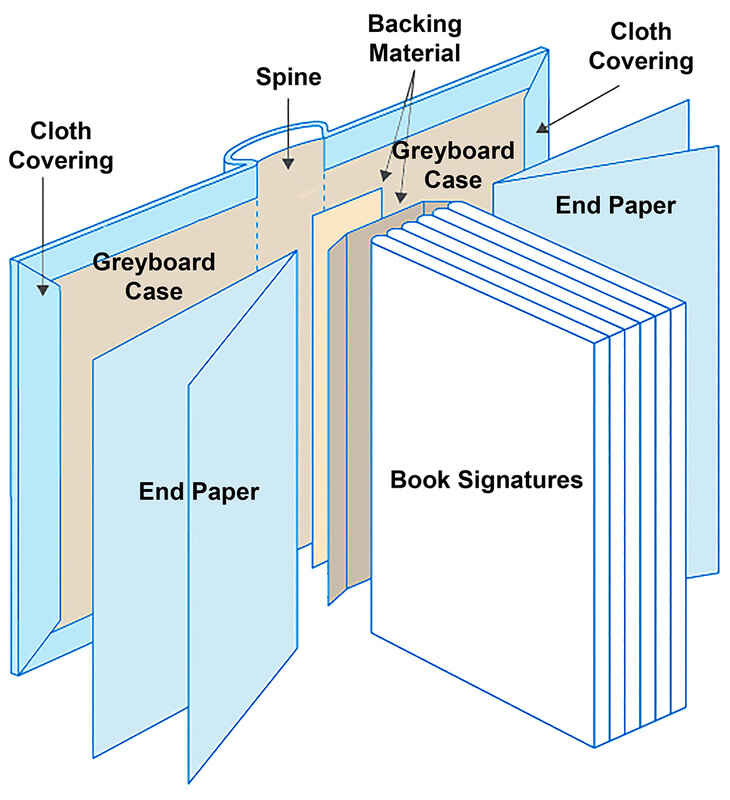
Hardcovers introduce a different structure involving boards, joints, hinges, endpapers, spine materials, and casing-in.
A 450-page casebound novel may therefore need to be evaluated differently from a 450-page paperback.
If you are still choosing the physical format, compare the manufacturing implications in our hardcover vs. paperback guide for bulk book orders.
Do not finish the interior first and decide the binding afterward.
That sequence is backwards.
Another common prepress error is treating gutter, margin, safe area, and bleed as interchangeable.
They are not.
Bleed is artwork extending past the trim edge so a background can be cut cleanly.
Safe area protects important content from trim and production variation.
Inside margin keeps content away from the bound edge.
Gutter may refer either to that inside margin or to additional binding allowance, depending on the software and printer.
Our guide to bleed, trim, and safe area explains these production zones in more detail.
For a normal black-text novel, interior pages usually do not need bleed unless a graphic, ornament, image, or background reaches the edge.
The gutter still matters on every page.
Software terminology deserves attention because I have seen theoretically correct numbers become incorrect files purely because they were entered into the wrong field.
For a conventional novel:
Do not build a left-page template and manually copy it to the right.
Let the facing-page geometry do its job.
Use Mirror margins for a bound novel.
Word may expose a separate Gutter field depending on how the document is configured. This is where authors accidentally double the allowance.
If your printer tells you:
Inside margin = 0.75 inch
do not automatically enter:
Inside = 0.75 + Gutter = 0.25
unless the printer explicitly says the total should be 1.00 inch.
Amazon’s own Word formatting guidance tells users working with mirror margins to enter the required inside margin while leaving its separate Gutter field at zero in that workflow.
Terminology matters.

It is easy.
It also ignores the binding.
A 0.5-inch inner margin may be perfectly workable for one 250-page novel and irritatingly tight on another 650-page edition.
A 140,000-word manuscript does not have a final book page count.
Typography creates the page count.
Set the actual trim, font, font size, leading, paragraph treatment, chapter openings, and front matter before calculating the final gutter.
A flat PDF has no spine.
No paper stiffness.
No glue.
No page curvature.
No hand holding it open.
A PDF can therefore lie beautifully.
Two sheets labelled with similar gsm values can have different bulk and stiffness.
Always obtain the real stock specification and, for demanding titles, a physical dummy.
This is the one I dislike most.
For a 600-page publication, evaluating only loose digital proofs tells you almost nothing about gutter visibility.
Bind something.
Even a representative dummy is better than guessing.
The Rhode Island School of Design’s book-design guidance makes the same basic point: binding consumes some of the inside margin, so extra room must be allowed, and its workflow recommends producing a physical prototype before final production.
Before approving a thick-novel interior, I would verify:
Only then would I consider the interior finished.
And after that, the production PDF still needs to be checked independently. Our print-ready PDF guide covers trim geometry, embedded fonts, PDF/X-4, resolution, bleed, color handling, and preflight.
A thick novel generally needs an inside gutter of roughly 0.625–0.875 inch for many 300–700-page layouts, with the final value determined by page count, paper caliper, trim size, and binding behavior rather than page count alone; very thick perfect-bound books may require still more room after physical testing.
For comparison, KDP currently specifies 0.625 inch for 301–500 pages and 0.75 inch for 501–700 pages. Offset printers may use different production parameters, so those figures should be treated as useful benchmarks rather than universal specifications.
The best margins for a 500-page novel usually combine an inside margin around 0.625–0.75 inch with a somewhat smaller outside margin, plus enough top and bottom space for running heads and folios, but the correct geometry should be confirmed against the actual trim size, paper, binding, typography, and physical proof.
For a 6 × 9-inch novel, I would usually prototype the interior around that range rather than forcing the same 0.5-inch margin onto every edge.
Perfect binding often benefits from more conservative gutter planning because its glued spine normally prevents the book from opening as freely as a well-constructed sewn text block, leaving more content visually buried near the spine; however, paper stiffness, grain direction, adhesive, thickness, and cover structure can alter the result substantially.
This is why binding should be specified before the interior is finalized.
Gutter size for a thick book should be calculated by combining the final page count with paper caliper, resulting text-block thickness, binding method, trim width, and expected opening behavior, then testing the proposed inside margin on a bound proof rather than relying on a page-count formula as the only variable.
Page count provides the starting benchmark. Physical thickness tells you what book you are actually manufacturing.
Inside and outside margins do not have to be identical in a novel because the inside edge must compensate for page curvature and binding loss while the outside edge remains fully exposed, so professional book layouts commonly balance the two margins according to reading comfort, page proportion, trim width, and binding construction.
For thick books especially, forcing equality can make the text appear too close to the spine.
A book gutter that is too small pushes text into the curved or concealed area near the spine, forcing readers to pull the book farther open to read complete lines, which can reduce comfort, increase stress on the binding, make the layout appear poorly manufactured, and create problems for annotations or photocopying.
The defect can be subtle on screen and obvious in the finished book.
A 0.5-inch gutter can be enough for a relatively short or flexible novel, but it becomes increasingly risky as page count, paper bulk, and spine thickness increase; once a book reaches roughly 300–500 pages or more, the binding and paper specification should be evaluated before accepting 0.5 inch as the final inside margin.
For example, KDP’s current minimum moves from 0.5 inch at 151–300 pages to 0.625 inch at 301–500 pages.
Do not approve a 500-, 600-, or 700-page novel because the PDF looks balanced at 100% zoom.
Send the printer the final trim size, final page count, paper specification, binding method, interior PDF, cover format, and planned quantity. Ask them to calculate the physical spine, review the gutter, check the text safe area, and confirm whether the proposed interior geometry still works after binding.
For publishers, independent authors, and print distributors preparing long fiction titles, explore JetPrint’s novel printing options and request a production review before mass printing.
The gutter is cheap white space.
A bad reprint isn’t.

Leave Your Comments