Start Your Book Printing Project
Share a few details about your book. JetPrint will review your specifications and help you identify the suitable printing, paper, binding, and finishing options for your project.
Glue gets blamed.
Yet the failure that buyers call “bad glue” often begins earlier, with coated stock, incorrect grain direction, weak spine preparation, insufficient curing, or a binding specification that never matched the book’s intended service life.
So why do print quotes reduce the decision to one checkbox?
The blunt answer is convenience. “Sewn binding” sounds durable. “Perfect binding” sounds economical. Buyers select one, the printer supplies a price, and nobody asks what kind of thread sewing, what adhesive chemistry, what spine treatment, or how the finished books will be tested.
That is a mistake.
Perfect binding is an adhesive binding process normally associated with square-spined paperback books. Sewn binding joins folded sections, usually called signatures, with thread before the text block is attached to its cover. Smyth sewn binding is one widely recognized form of thread sewing through folded signatures.
My position is simple: sewn binding usually offers better structural security and opening behavior, but a properly engineered perfect-bound book can be the smarter commercial product. The correct choice depends on the book, not on which term sounds more expensive.
And physical books remain commercially serious products. A June 2026 market report from the U.S. International Trade Administration reported that German print-book sales generated approximately USD 7.72 billion in 2024, while 67,467 new titles were published in 2023. Binding decisions are therefore not decorative production details; they affect products moving through a multibillion-dollar market.
| Factor | Sewn Binding | Perfect Binding |
|---|---|---|
| Basic construction | Folded signatures are stitched together with thread | Pages or sections are secured at the spine with adhesive |
| Common alternatives | Thread sewn, section sewn, Smyth sewn | EVA perfect binding, PUR perfect binding, double-fan adhesive binding |
| Opening behavior | Usually opens more comfortably and tolerates repeated flexing | Often resists opening near the gutter, depending on paper and spine construction |
| Page security | Thread provides mechanical attachment through the folds | Page retention depends heavily on paper, adhesive, spine preparation, and curing |
| Production speed | More production stages and handling | Generally faster and easier to automate |
| Typical commercial use | Premium hardcovers, textbooks, reference books, illustrated titles | Paperback novels, catalogs, reports, manuals, short-life publications |
| Cost tendency | Usually higher | Usually lower, although specifications can narrow the difference |
| Best reason to choose it | Long service life and frequent handling | Efficient production for price-sensitive or shorter-use projects |
| Main risk | Paying for sewing that the product does not need | Assuming every adhesive-bound book will perform equally |
| Quality-control focus | Sewing consistency, section alignment, swell, casing, opening | Adhesive compatibility, spine preparation, curing, page-pull strength |
This table is a starting point, not a purchasing specification. A thin, well-manufactured PUR-bound paperback may outperform a poorly folded and badly cased sewn book. Labels do not rescue weak production.
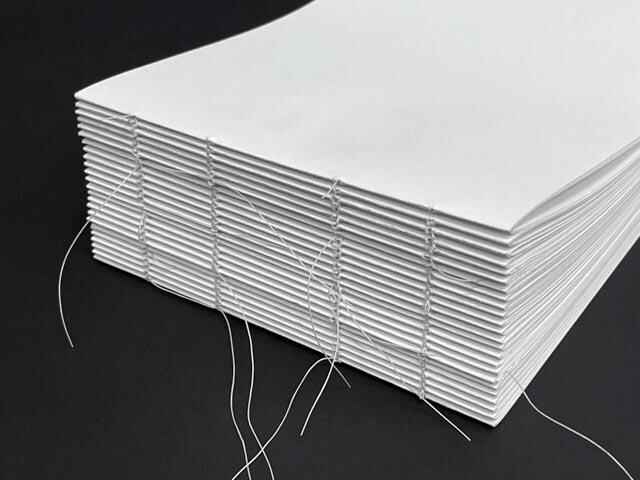
In a thread sewn binding, printed sheets are folded into signatures. The signatures are gathered in sequence and sewn through their folds. Depending on the production line and book format, the sewn text block may then receive spine adhesive, gauze or mull, paper lining, endpapers, and a cover or case.
The thread is the major structural difference. Pages are not relying only on a film of adhesive at a cut edge; they remain part of folded sections physically connected through the spine.
The University of Illinois Preservation Self-Assessment Program describes through-the-fold binding as signatures sewn through holes in their folded edges, often over cords or tapes that provide additional text-block support. It also distinguishes this structure from perfect binding, where hot-melt adhesive is applied to the spine.
This matters most when a book will be opened repeatedly, pressed down during use, photocopied, carried in bags, or handled by children, students, technicians, cooks, musicians, and other readers who are not going to treat it like an exhibit.
But sewing creates its own engineering issues. Thread adds spine swell. Thick thread, heavy signatures, excessive adhesive, or poor rounding can produce a bulky spine and uneven boards. “Sewn” is not a magic quality certificate.
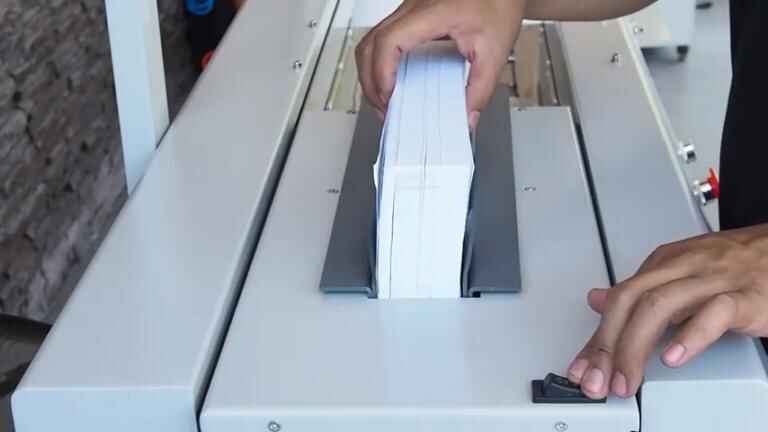
Perfect binding generally starts with gathered pages or folded sections whose spine edge is cut or prepared. Adhesive is applied across the spine, and a wraparound cover is attached to create a clean square back.
The process is efficient. That is why perfect binding dominates many paperback, catalog, report, and manual projects.
Older discussions often treat all perfect binding as if it used one brittle hot-melt glue. Modern production is more varied. EVA, or ethylene-vinyl acetate, remains widely associated with conventional hot-melt binding. PUR, meaning polyurethane-reactive adhesive, is chosen for projects requiring stronger adhesion, flexibility, or better performance with difficult stocks.
But adhesive names are not enough. Adhesive temperature, open time, film thickness, spine roughening, paper coating, ink coverage near the spine, production speed, cooling, curing, and storage all affect the result.
The University of Illinois notes that conventional perfect binding provides a less secure bond than double-fan adhesive binding because adhesive does not penetrate between the sheets in the same way. Yet it also states that adhesive bindings can be economical and suitable for books receiving heavy use over a comparatively short period.
That is the part sales brochures usually omit: a binding can be fit for purpose without being designed for several decades of circulation.
Perfect binding and adhesive binding are often used as synonyms in print quotations, but they are not always technically identical.
Double-fan adhesive binding, for example, fans loose pages in both directions while polyvinyl acetate adhesive is applied, allowing the adhesive to reach farther between the leaves. The University of Illinois describes this method as producing a more secure bond and a text block that can lie open flatter than basic perfect binding.
The Northeast Document Conservation Center’s library-binding guidance even recommends double-fan adhesive binding for many books that cannot be recased or resewn through their folds. That destroys the lazy argument that thread is always respectable and adhesive is always inferior.
Method matters.
I distrust any printer who answers a durability question with “Don’t worry, we use good glue.”
Good according to what test?
Perfect-binding strength can be measured through page-pull testing. ISO 19594:2017 is specifically titled “Graphic technology — Test method for the determination of the binding strength for perfect-bound products — Page-pull test working upwards.” The test applies a force perpendicular to the spine and evaluates the force required to remove a page relative to the book’s format height.
Fogra’s bookbinding examination service recommends testing at least five samples from each production being compared. The conditioned samples are tested on a calibrated device according to ISO 19594, producing a sheet tear-out strength rather than a vague visual opinion. Fogra currently lists the individual pull-test price at €8.33 for members and €11.90 for non-members.
That small detail exposes an industry hard truth: objective testing can cost less than the courier charge for a carton of defective books, yet many purchasing specifications never request it.
For a commercial order, I would ask for:
JetPrint’s book printing and finishing capabilities should be reviewed alongside the binding specification because printing, folding, gathering, sewing, gluing, trimming, and casing operate as one production chain. A defect introduced before binding can surface later as a “binding failure.”
A Fogra research project conducted from June 1, 2021, to May 31, 2023, investigated the perfect-binding behavior of uncoated papers used in high-speed inkjet production.
The findings were not flattering to simplistic purchasing rules.
After manual and industrial bonding trials followed by pull tests, Fogra reported a strong material influence from both the paper and the adhesive. Paper thickness and specific volume were identified as particularly important parameters. The project also found that high-frequency drying could increase bubbles in the adhesive and reduce pull-test values under the tested conditions.
In other words, “PUR binding” written on a quotation does not tell you enough. Nor does “80 gsm uncoated paper.” The combination and process settings determine the bond.
That is why buyers planning custom book printing should submit the actual trim size, page count, paper, ink coverage, cover structure, expected use, and required opening behavior before asking which binding is best.
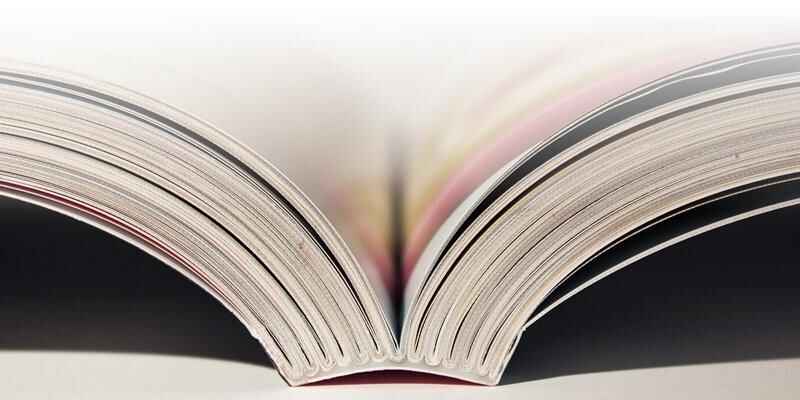
Strength is not the only objective. A book must open without damaging itself.
In 2025, the Library of Congress documented the conservation of the Warburg Book of Hours, a manuscript dating to around 1500. An early nineteenth-century rebinding had left the book so stiff that comfortable opening was obstructed. Heavy hide glue complicated the treatment.
The Library’s senior book conservator removed the problematic binding, reduced adhesive in the gutters, repaired the folds, sewed the book onto raised supports, and constructed a non-adhesive spine to improve flexibility. Two prototype bindings were created before the final structure was produced. The Library of Congress case study states that the result could be shown, read, and digitized without compromising the manuscript’s long-term condition.
A commercial paperback is not a sixteenth-century manuscript. Obviously.
But the lesson transfers: a binding that merely holds pages together may still fail if it cannot open comfortably for its intended use.
Sewn binding normally costs more because signatures must be planned, folded, gathered, sewn, and processed before casing or cover attachment. It can also create more production constraints around page count, imposition, paper bulk, and spine swell.
Perfect binding is usually faster because the line can gather, prepare, glue, cover, and trim books with fewer structural steps.
Usually.
A low-cost perfect-bound book can become expensive when the selected stock is difficult to bond, the spine requires special preparation, PUR curing affects the schedule, a very small quantity creates inefficient setup, or failed samples force rework.
At the same time, sewn binding can be wasteful when the book is a low-price promotional title with a short distribution window and little chance of repeated use.
I would never approve the extra cost of sewing merely because someone inserted “premium” into the product brief. Spend money where the reader can feel it or where failure carries a real commercial cost.
Before comparing quotations, review the factory’s book printing production profile and ask whether the sewing, binding, casing, and quality checks are performed within a controlled workflow or transferred among unrelated subcontractors. A polished sales PDF tells you less than a traceable production route.
A useful quotation should identify at least these factors:
| Specification | Why It Changes the Binding Decision |
|---|---|
| Final trim size | Changes leverage on the spine and affects imposition |
| Page count | Determines spine width, text-block weight, and signature planning |
| Paper weight | Heavier pages place more load on the spine |
| Paper thickness and bulk | Affect spine width and adhesive behavior |
| Coated or uncoated stock | Changes surface and edge-bonding behavior |
| Grain direction | Wrong grain can resist opening and increase spine stress |
| Ink or coating near the spine | May interfere with adhesive bonding |
| Cover type | Paperback covers and rigid cases transfer forces differently |
| Expected frequency of use | A disposable catalog and a school textbook have different service requirements |
| Required opening angle | Reading, writing, scanning, and display uses are not equivalent |
| Print quantity | Influences setup economics and available production methods |
| Distribution environment | Heat, cold, transport compression, and storage can expose weak construction |
A quotation that says only “perfect binding, 1,000 copies” is not yet a binding specification. It is a price placeholder.
Perfect binding is normally the practical choice for price-sensitive paperback novels, short-run titles, and general trade books that need a professional square spine without the cost of section sewing.
PUR may be worth discussing when the title has heavy ink coverage, demanding stock, a high page count, or stronger opening requirements. But do not pay for PUR as a label. Ask how the paper-and-adhesive combination will be validated.
Choose sewn binding when the paperback is intended as a durable premium edition, will receive repeated institutional use, or must open more comfortably than a standard adhesive-bound novel.
Sewn binding generally earns its price here.
These books are opened repeatedly, carried, marked, pressed flat, and used over months or years. A thread sewn text block gives the pages a mechanical connection that remains even if portions of the spine adhesive age or crack.
But very frequently consulted manuals may need a binding that lies fully flat. Depending on the project, Wire-O, spiral, concealed Wire-O, or another mechanical binding may outperform both sewn and perfect binding. Do not force every book into a conventional square spine.
Sewn binding is often preferred for premium illustrated books because readers expect controlled opening, durable sections, and a substantial physical feel.
Paper creates complications. Heavy coated stocks place significant stress on the spine, and cross-spread images expose any loss in the gutter. A sewn structure may help, but it does not eliminate image loss automatically. Layout margins, section design, board construction, and the chosen spine structure still matter.
For image-led projects, request a bound prototype using the actual paper rather than an unprinted dummy made from “similar” stock.
A conventional perfect-bound structure is rarely my first recommendation for a heavily handled children’s title.
Young readers pull pages, reverse-fold covers, open spreads forcefully, and carry books with little concern for the spine. Sewn hardcover construction, board-book structures, reinforced bindings, or other age-appropriate formats may be better choices.
The correct solution depends on age group, page material, safety requirements, book size, and whether the title is intended for homes, schools, or libraries.
Opening behavior comes first.
A journal that fights the user every time they write near the gutter has failed, even if no page ever detaches. Sewn binding can improve usability, but exposed sewing, lay-flat adhesive methods, Wire-O, and casebound structures should also be considered.
Ask how the prototype behaves on the first page, middle spread, and final page. Many samples are tested only in the center, where they naturally open more easily.
Ask whether the book is Smyth sewn, section sewn, side sewn, or simply stitched before adhesive binding. These structures do not offer the same opening behavior.
Also ask whether the pages are true folded signatures. Loose leaves cannot be sewn through a fold that does not exist.
Ask whether the line uses EVA, PUR, another hot-melt system, or a cold-emulsion process. Then ask why that adhesive was selected for your paper.
The answer should discuss the stock and production conditions. “PUR is stronger” is not a complete technical explanation.
Paper grain should generally run parallel to the spine. When it runs across the spine, pages resist turning, the book may spring closed, and repeated opening places extra stress on the binding.
A printer that treats grain direction as an optional detail is treating the book as a stack of printed rectangles rather than a functioning object.
A printed sheet proves color. It proves almost nothing about the finished binding.
For a substantial order, the approval sequence should include a bound dummy or finished prototype. Where possible, it should use the intended paper, approximate page count, cover construction, and binding method.
“Strong,” “premium,” and “long-lasting” are sales adjectives.
ISO 19594 page-pull testing, comparative sample testing, controlled opening checks, and documented inspection criteria are evidence. Ask for evidence.
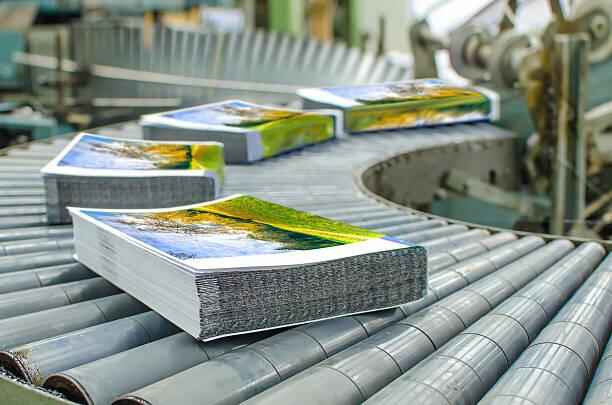
Perfect binding is an adhesive binding method in which individual pages or folded sections are gathered, the spine edge is prepared, and a flexible cover is glued around the text block, creating the square spine commonly used for paperback novels, catalogs, manuals, and other commercially produced books.
Its performance depends on the paper, adhesive, spine preparation, film thickness, curing conditions, grain direction, and intended use. EVA and PUR systems should not be treated as interchangeable without testing the actual stock.
Sewn binding is a bookbinding method in which folded groups of pages, called signatures, are joined with thread through their folds before the assembled text block is attached to a soft cover or rigid case, providing mechanical page security and generally more flexible opening than basic adhesive binding.
Thread sewn binding and Smyth sewn binding are commonly specified for books expected to receive repeated handling, including textbooks, reference titles, premium hardcovers, illustrated books, and durable trade editions.
The best book binding is the structure that matches the book’s paper, page count, trim size, opening requirement, expected handling, service life, budget, and production quantity; sewn binding normally favors durability and repeated use, while perfect binding normally favors efficient production and lower unit cost.
A printer should evaluate the complete specification rather than recommend one method solely from the product category.
A standard perfect-bound book does not normally lie completely flat because its pages are attached along a glued spine and the cover resists opening, although flexible adhesives, suitable paper, controlled spine preparation, wider inner margins, and specialized lay-flat adhesive structures can substantially improve its opening behavior.
For workbooks, cookbooks, music books, and journals, approve a physical prototype rather than relying on the phrase “lay flat.”
Smyth sewn binding is a type of thread sewn binding in which folded signatures are mechanically sewn through their folds and joined into a text block, while “thread sewn” is a broader commercial term that may describe several section-sewing processes and should therefore be clarified on the printer’s specification.
Buyers should confirm the signature structure, thread method, spine treatment, and final cover attachment.
Perfect-binding strength can be tested with a controlled page-pull procedure, such as the method defined by ISO 19594:2017, in which a page is pulled perpendicular to the spine, the maximum force is recorded, and the result is evaluated relative to the height of the bound product.
Comparative testing should use multiple conditioned samples from representative production cartons, not one hand-selected book from the bindery.
Sewn binding generally provides greater mechanical page security because thread joins folded signatures, but it is not automatically superior to every glued structure; a well-produced double-fan or PUR adhesive binding may outperform poor sewing, incorrect folding, weak casing, excessive spine adhesive, or a design that prevents comfortable opening.
Production quality and fitness for use matter more than the prestige of the label.
Do not ask a printer, “How much is perfect binding?”
Ask for the price of a defined book.
Provide the trim size, final page count, paper name or technical data, print process, ink coverage, cover structure, quantity, target market, expected frequency of use, required opening behavior, and planned distribution conditions. Then request the recommended binding method, adhesive system, prototype procedure, and quality-control standard.
For a project-specific evaluation, contact the book production team with your PDF, page specification, paper preference, quantity, and intended application. Request both a sewn-binding and perfect-binding assessment where the choice remains open.
The lowest quotation is easy to find.
The lowest total risk is not.

Leave Your Comments