Start Your Book Printing Project
Share a few details about your book. JetPrint will review your specifications and help you identify the suitable printing, paper, binding, and finishing options for your project.
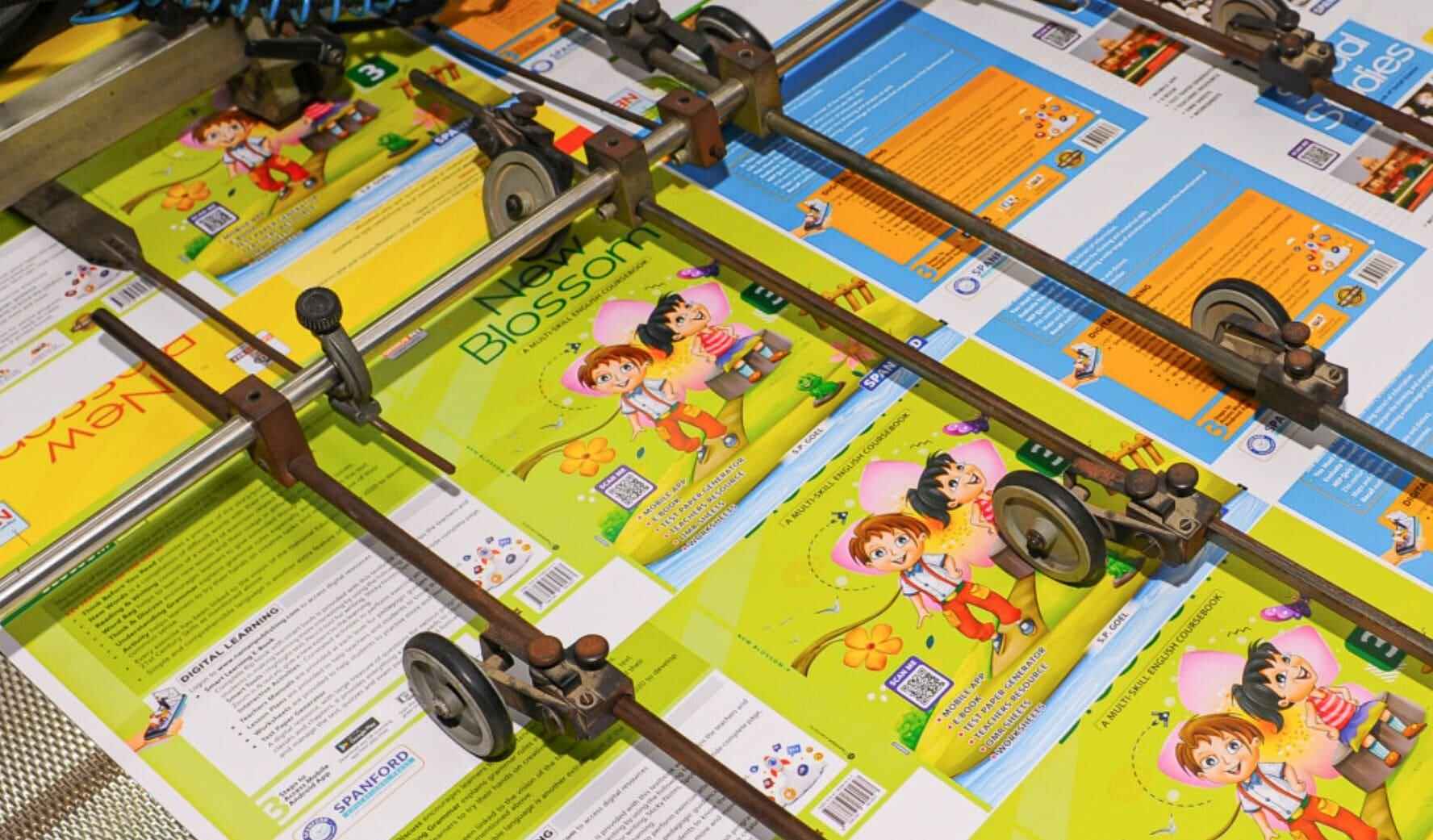
Printing exposes weakness.
An activity book manuscript can look polished on a monitor yet fail in a classroom because the paper smears, the binding fights the child’s hand, the answer spaces disappear into the gutter, or the illustrations reproduce as muddy gray blocks.
Why do publishers still approve these products by looking at a screen PDF?
The demand for effective educational materials is not theoretical. The 2024 National Assessment of Educational Progress tested approximately 117,400 fourth-grade students and found that the national reading score had fallen two points since 2022 and five points since 2019. More disturbing, 40% of fourth graders performed below the NAEP Basic level. The full findings are available in the 2024 NAEP Reading results and its national achievement analysis.
Printed activities will not solve a national literacy problem by themselves. That claim would be marketing nonsense. But a properly designed workbook can give teachers structured practice, give parents visible evidence of progress, and give children a physical place to write, circle, match, calculate, color, and correct mistakes.
The United Kingdom’s 2026 National Year of Reading campaign was launched after government figures showed that only one in three people aged 8–18 reported enjoying reading in their free time. Among boys, the figure was 25%, compared with 39% among girls. Those numbers make engagement a commercial issue for educational publishers as much as a teaching issue.
My position is blunt: activity book printing should be managed as product engineering, not as a final purchasing task handed to a printer after editorial work has ended.
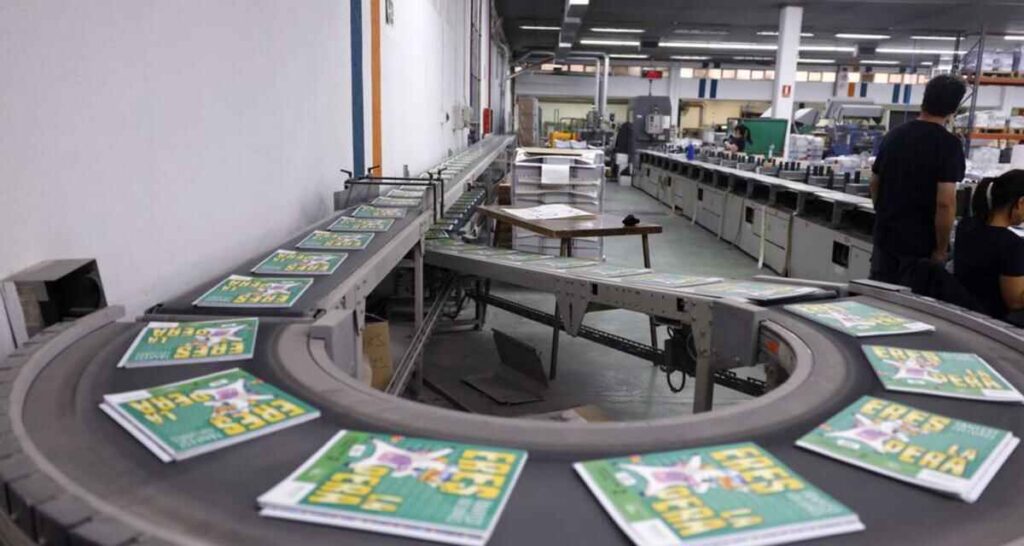
A children’s activity book is used differently from a storybook. The reader writes on it. Erases it. Folds it. Presses a crayon against it. Sometimes removes pages, applies stickers, cuts shapes, or carries the book between home and school for months.
That physical behavior should determine the specification.
Before requesting custom book printing services, publishers should define six things:
These questions sound elementary. They are not.
A tracing workbook for four-year-olds requires heavier lines, larger working areas, generous margins, and paper that tolerates repeated pencil pressure. A mathematics workbook for ten-year-olds may need narrower answer spaces, more pages, and stronger binding. A sticker activity book introduces release liners, kiss-cutting tolerances, adhesive selection, and additional product-safety questions.
The UK Department for Education’s Beech Grove Primary School case study describes reading as a whole-school system built around fluency, confidence, and reading for pleasure. That is the useful lesson for publishers: a book works inside a teaching system, not in isolation.
| Activity-book format | Typical paper direction | Practical binding choice | Main production risk | What the publisher must test |
|---|---|---|---|---|
| Pencil and handwriting workbook | Opaque uncoated paper | Saddle stitch or perfect binding | Show-through and tight gutters | Pencil response, erasing, writing near spine |
| Coloring and puzzle book | Uncoated paper with enough bulk | Saddle stitch or perfect binding | Marker bleed and weak black outlines | Crayon coverage, marker penetration, line density |
| Classroom workbook | Durable uncoated paper | Perfect, sewn, or Wire-O binding | Pages loosening during repeated use | Page pull, opening behavior, cover durability |
| Sticker activity book | Mixed text stock and release liner | Saddle stitch or perfect binding | Incorrect kiss-cut depth or adhesive behavior | Sticker removal, repositioning, liner separation |
| Cut-and-make activity book | Uncoated paper with suitable stiffness | Saddle stitch or removable sheets | Cutting difficulty and unsafe small pieces | Scissor use, grain direction, detachable components |
| Teacher-led reusable workbook | Coated or laminated writing surface | Wire-O or concealed Wire-O | Marker ghosting and damaged lamination | Dry-erase performance, edge wear, cleaning |
The table is not a universal prescription. It is a testing map. Paper mills, inks, coatings, writing tools, climatic conditions, and page designs behave differently, which is why a physical prototype matters more than a sales description.
Educational publishers often specify paper by weight alone: 80 gsm, 100 gsm, 120 gsm.
That is incomplete.
Two papers with the same grammage can have noticeably different opacity, stiffness, surface texture, bulk, brightness, and ink absorption. A high-brightness sheet may make illustrations appear clean, yet increase glare under classroom lighting. A smooth coated sheet may produce stronger photographs, yet frustrate a child trying to write with a pencil.
For most handwriting, puzzle, and coloring applications, uncoated woodfree paper is the safer starting point. Common evaluation ranges include approximately 80–120 gsm, but the final choice should be based on physical testing rather than a number copied from a previous title.
A production dummy should be tested with the tools named in the instructions:
A book marketed for “coloring” but tested only with a pencil proof has not been tested.
Marker-heavy activities may require a heavier or more opaque sheet, yet even thick paper cannot guarantee zero bleed-through with every alcohol-based marker. The honest solution is to specify recommended tools, test representative brands, and design single-sided activities when bleed-through would destroy content on the reverse.
I also reject the automatic assumption that premium paper means glossy paper. For a child who must write on every page, an expensive coating can reduce usability rather than improve it.
Publishers can review available processes through JetPrint’s printing capabilities, but the final decision should be made using printed and writable samples.
Children’s activity book printing often depends on clean black outlines. Coloring pages, maze borders, handwriting guides, number grids, and cut lines must remain sharp without appearing overloaded.
For most interior line art, black should normally be built as 100% K rather than four-color rich black. Four-color black can create registration halos around fine lines, particularly when cyan, magenta, yellow, and black plates do not align perfectly.
Rich black may still be appropriate for large cover areas. It is usually the wrong choice for:
Grayscale images also require attention. Converting a color illustration to grayscale at the final prepress stage can flatten contrast and hide instructional details. Publishers should inspect the actual CMYK or grayscale output, not rely on how an RGB monitor displays it.
A visually attractive workbook that refuses to stay open is badly manufactured.
There. I said it.
Educational publishers sometimes select perfect binding because it looks more substantial on a retail shelf, even when the activities run close to the spine and children must hold the book open with one hand while writing with the other.
Saddle stitching is efficient for thinner books and allows relatively easy opening. The total page count normally needs to be divisible by four because sheets are folded into four-page units.
A practical range may be approximately 8–64 pages, depending on trim size, paper thickness, cover stock, and acceptable spine swelling. Publishers should not treat 64 pages as an automatic maximum. A thick 64-page book can suffer from page creep, protruding inner sheets, and an untidy fore-edge.
Creep compensation must be included during imposition. Otherwise, page elements close to the outer edge may shift after folding and trimming.
Perfect binding produces a square spine and suits thicker educational books, but it consumes part of the inner margin. Answer boxes, cutting guides, and instructions placed too close to the spine become difficult to use.
The publisher should approve a bound dummy that confirms:
PUR adhesive can provide stronger performance than conventional EVA in demanding applications, particularly when coated stock, heavy ink coverage, or temperature variation is involved. But adhesive selection cannot repair poor grain direction, inadequate spine preparation, or a bad page layout.
Wire-O binding offers dependable lay-flat performance. It is useful for handwriting programs, teacher manuals, music exercises, language drills, and workbooks used beside a computer or laboratory setup.
Its disadvantages are equally real: higher manufacturing complexity, exposed metal, more packaging space, and possible wire deformation during transport.
Sewn binding is appropriate when repeated institutional use matters more than the lowest unit cost. It can support longer service life, but publishers should still test how the completed book opens. Sewing alone does not guarantee a perfectly flat writing surface.
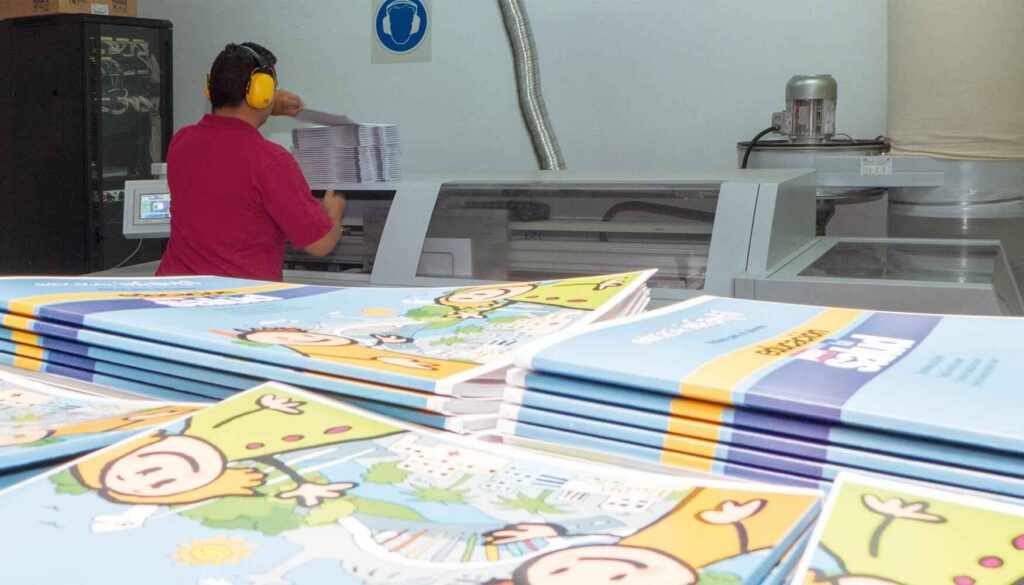
The best printing method is not simply the one with the lowest quoted unit price.
Offset printing usually becomes more economical when a publisher has a stable design, a larger print quantity, consistent regional content, and confidence that the edition will sell or be adopted. Digital printing is more useful for prototypes, pilot programs, small editions, personalized content, and books likely to change after classroom testing.
That distinction matters because educational titles are revised frequently.
A publisher may need to correct:
Printing 50,000 copies of an untested edition is not efficiency. It is a warehouse problem with a lower theoretical unit price.
A sensible production plan can use digital printing for the pilot edition, gather teacher and student feedback, revise the files, and then move the stable edition to offset production. That is how to print children’s activity books without allowing the purchasing department to overrule editorial reality.
Publishers routinely compare quotations by unit price while ignoring spoilage, replacements, corrections, freight volume, unsold localized editions, and damaged classroom copies.
I prefer a broader calculation:
Usable landed cost = manufacturing + proofing + inspection + freight + duty + corrections + replacements + expected waste
Consider an illustrative example. Saving $0.02 per copy appears meaningful across 100,000 books because it reduces the purchase order by $2,000. But if the cheaper paper causes only 3% of the books to be rejected, replaced, or discounted, the apparent saving can disappear immediately.
That is not a price quotation. It is a warning about scale.
Small specification choices multiply:
The most economical educational book is usually the one designed around a standard press sheet, efficient signature count, appropriate paper, controlled versioning, and realistic durability target.
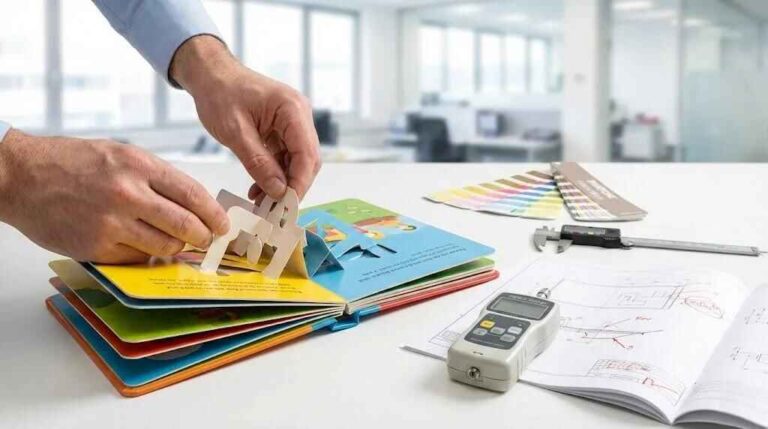
A loose digital proof is not a complete activity-book prototype.
It can confirm text, page order, basic image placement, and obvious mistakes. It cannot fully prove opening behavior, paper opacity, pencil response, cutting performance, sticker release, lamination durability, or carton packing.
Educational publishers should use a proof hierarchy.
Review spelling, instructions, answer keys, page numbers, ISBN data, copyright information, and edition identifiers.
Review important illustrations, skin tones, branded colors, warning graphics, and contrast between activity elements.
Confirm trim size, paper bulk, spine width, inner margins, opening behavior, cover stiffness, and physical usability.
Write, erase, color, cut, fold, remove stickers, scan QR codes, and perform each activity exactly as a child would.
Confirm that the mass-produced result matches the approved standard before the full shipment is released.
This process may feel slower at the beginning. It is faster than reprinting.
Publishers should not assume that every paper product is legally treated as an ordinary book.
Under current U.S. Consumer Product Safety Commission guidance, accessible components of children’s products generally must comply with a total lead limit of 100 parts per million. “Ordinary books” and certain paper-based printed materials can qualify for exclusions from third-party lead testing, but the definition does not automatically cover books intended for children aged three or younger, books with play value, or toys and other articles packaged with a book. See the CPSC’s children’s books guidance and total lead content guidance.
This distinction can affect books containing:
The European Union also updated its toy rules through Regulation (EU) 2025/2509. The regulation entered into force on January 1, 2026, and is scheduled to apply from August 1, 2030, after a four-and-a-half-year transition. It introduces stronger chemical controls and a digital product passport for products classified as toys. Until the new rules apply, publishers must continue to account for the existing Toy Safety Directive and other applicable laws.
European Commission guidance has historically treated coloring and painting articles as toys when they are intended for play rather than professional artistic use. Classification therefore depends on the product’s design, stated purpose, age grading, components, packaging, and foreseeable use—not merely the fact that it contains printed pages.
Publishers should obtain market-specific legal and laboratory advice before production. A printer can support material documentation and sample preparation, but the brand owner, manufacturer, importer, or responsible economic operator must understand its own compliance duties.
Prepress is where inexpensive corrections are made. Production is where those same corrections become expensive.
A print-ready package should include:
PDF/X-4 is often a useful exchange standard because it supports modern transparency and color-managed workflows, although the printer’s required PDF standard should control the final export.
The dangerous file is not the visibly broken one. It is the file that looks normal but contains an outdated answer page, an RGB illustration, an accidental overprint, a low-resolution replacement image, or a sticker dieline shifted by 1 mm.
Every educational title should have a page map showing:
A page map is especially valuable when several editors, designers, translators, and production coordinators are working on the same title.
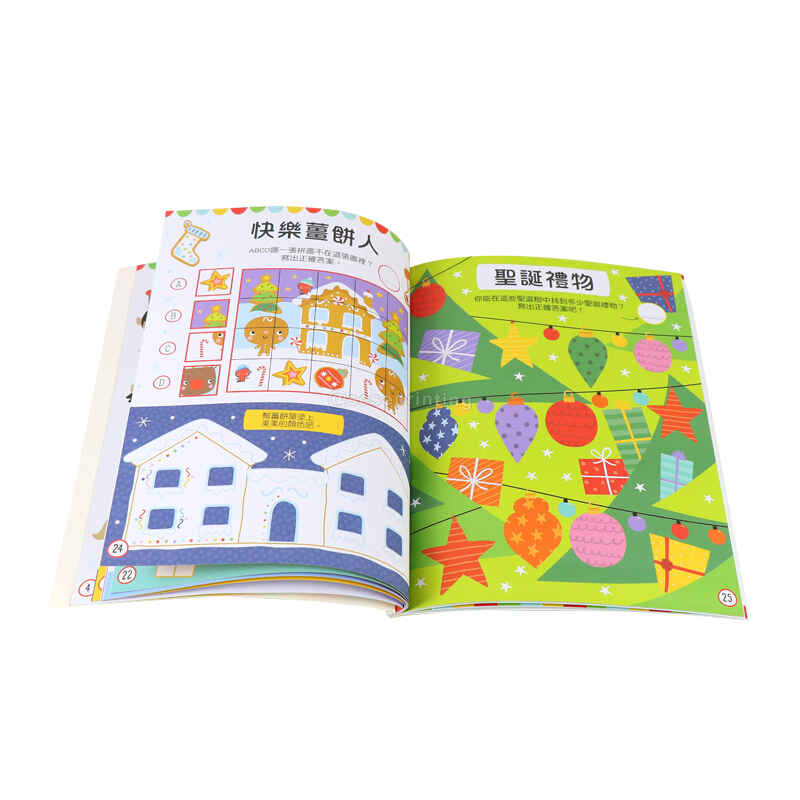
Generic print inspection is not enough.
An activity book can pass a basic visual inspection and still fail functionally. The inspector must know what the book is supposed to do.
For example, a sticker book should be checked for kiss-cut depth. The blade must cut through the sticker face material without cutting deeply into the release liner. Too shallow, and children cannot remove the sticker. Too deep, and the sticker sheet separates or tears.
A handwriting book should be checked for:
A cut-and-make book should be checked for alignment between front and reverse artwork, safe positioning of cutting lines, paper stiffness, and the behavior of folded components.
I would also require carton-level controls. Mixed language editions, incorrect cover versions, or missing sticker sheets can remain invisible until books reach a school, distributor, or fulfillment center.
A credible printing partner should ask questions before offering confident answers.
The printer should want to know the age group, writing tools, page count, trim size, binding, paper preference, color requirement, edition quantity, insert structure, target market, and compliance documentation.
Silence is not efficiency. It can mean the supplier is pricing an assumption.
Publishers evaluating activity book printing services should examine:
Information about the supplier, production focus, and operating approach should be checked before files are transferred. Publishers can review JetPrint’s company background and discuss a specific title through the production contact page.
The best supplier is not the one who says yes fastest. It is the one willing to identify a specification that will not work.
Activity book printing is the commercial production of educational books that require children to write, draw, color, match, cut, place stickers, or solve exercises directly on the page, using paper, ink, binding, and finishing specifications selected for both instructional use and repeated physical handling.
Unlike ordinary reading books, activity books must be tested for writing performance, opening behavior, page durability, opacity, and any interactive components.
The best paper for children’s activity books is usually an uncoated, opaque sheet in the 80–120 gsm range because it accepts pencil, crayon, and many pens better than glossy stock, although marker-heavy books may require heavier paper and physical testing to control bleed-through.
The correct paper depends on the writing tools, whether pages are printed on both sides, the required lifespan, and the book’s target price.
Offset printing is usually better for large, stable activity-book runs because its setup cost is spread across more copies, while digital printing is usually better for short runs, prototypes, personalized editions, and titles that may change after classroom or market testing.
Many educational publishers can reduce risk by testing a digital pilot edition before ordering a larger offset run.
The best binding for an educational workbook is the method that matches page count, writing behavior, and expected lifespan: saddle stitching for thinner books, perfect binding for thicker workbooks, Wire-O for reliable lay-flat use, and sewn binding for demanding institutional programs.
Publishers should test a physical bound dummy because page count alone does not reveal gutter loss, opening resistance, or writing comfort.
Children’s activity books may require product-safety testing when they contain play-value features, detachable components, crayons, magnets, plastics, coatings, or materials that place them outside the legal definition of an ordinary paper-based book in the country where they will be sold.
Age grading, packaging, intended use, and included accessories can all affect the product’s regulatory classification.
A print-ready activity-book file is a final PDF—preferably PDF/X-4 or another printer-approved standard—with correct trim size, bleed, embedded fonts, high-resolution images, controlled CMYK color, verified black line art, safe margins, page order, and separate dielines for stickers or special finishing.
Publishers should also provide a page map, edition code, finishing instructions, and a reference file showing how interactive elements are intended to function.
Publishers reduce activity-book printing cost most effectively by controlling page count, trim size, paper weight, color coverage, binding complexity, edition count, and revision timing before production, because late corrections and unnecessary specifications often cost more than a carefully chosen paper upgrade.
The correct comparison is total usable landed cost, not merely the lowest manufacturing price per copy.
Children’s activity book printing succeeds when editorial planning, instructional design, prepress, manufacturing, safety review, and quality control are treated as one connected process.
Do not approve the next title from a monitor alone.
Request a physical prototype. Write on it. Erase it. Color it. Open it flat. Remove the stickers. Check every answer. Give it to a teacher. Watch a child use it.
Then approve production.
For a specification review, prototype, or custom educational publishing project, contact JetPrint with the trim size, page count, target age, quantity, binding preference, paper requirements, and destination market.

Leave Your Comments