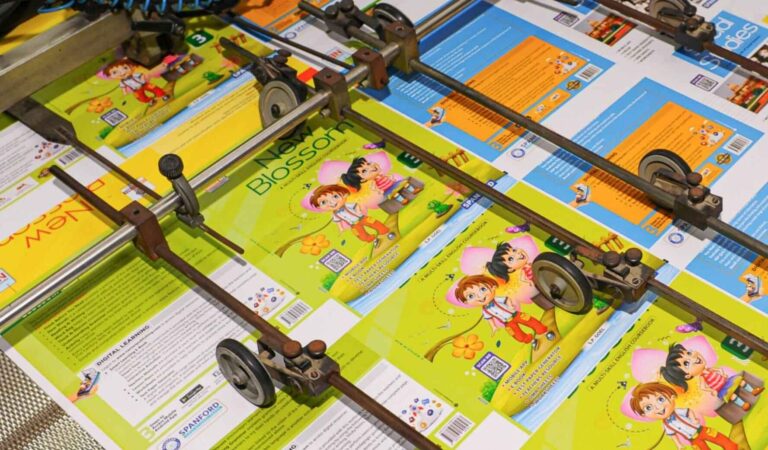
Start Your Book Printing Project
Share a few details about your book. JetPrint will review your specifications and help you identify the suitable printing, paper, binding, and finishing options for your project.
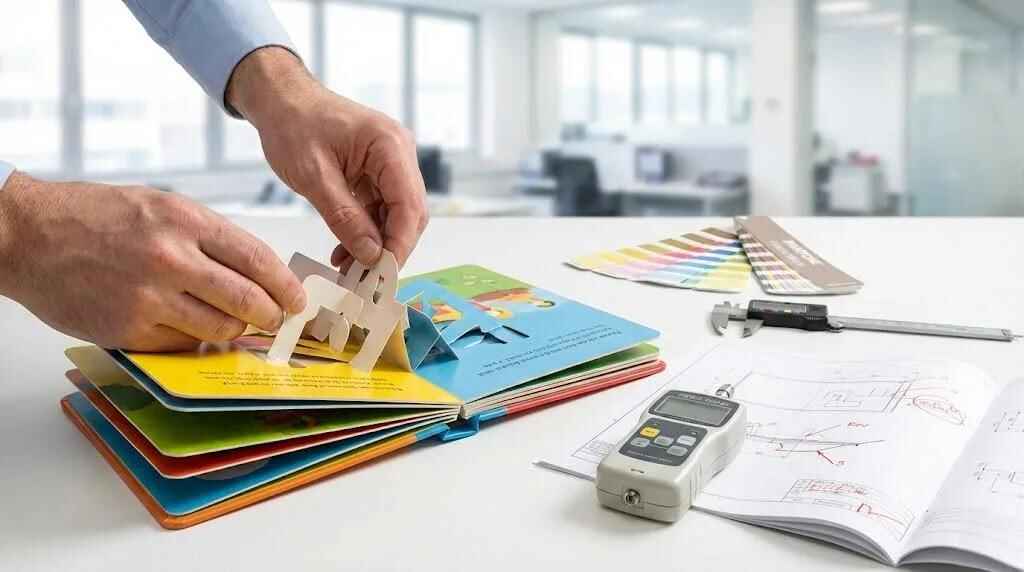
Books become toys.
When a toy company adds plastic rings, felt characters, spinning wheels, pull tabs, sound modules, reusable packaging, shaped pieces, or detachable accessories, the project moves beyond ordinary publishing and into a far less forgiving combination of print manufacturing, product engineering, child safety, and import compliance.
Why would any buyer manage that project with a basic book-printing quotation?
My view is blunt: a toy company should never purchase a board book by comparing unit prices alone. The specification, age grade, component structure, testing plan, packaging format, and traceability system matter more than a few cents saved at the quotation stage.
The correct starting point is a production brief that defines what the child will do with the product—not merely what the product will look like.
A conventional board book may contain only paperboard, printing ink, adhesive, and a protective finish. An interactive board book may contain plastic, textile, metal, foam, magnets, batteries, electronic modules, cords, fasteners, sliders, or separate play pieces.
That difference changes everything.
The U.S. Consumer Product Safety Commission defines a children’s product as a consumer product designed or intended primarily for children aged 12 or younger. More specifically, the CPSC’s children’s book guidance states that the testing exemption available to certain “ordinary books” does not cover books with inherent play value, books intended for children aged three or younger, or non-book toys and accessories packaged with a book.
This distinction is often misunderstood.
An exemption from a particular third-party testing requirement is not permission to ignore the underlying safety limit. For example, accessible components of U.S. children’s products generally must not exceed 100 parts per million of total lead, while paint and similar surface coatings must not exceed 90 ppm. Manufacturers and importers must determine which rules apply to the finished product, not merely to the printed sheets.
A toy company should therefore establish the following before requesting a price:
The factory can support production. But the brand owner and importer still need competent market-specific compliance advice.
Most quotation failures begin with an innocent-looking sentence:
“Please quote a 20-page board book.”
That sentence is almost useless.
Does “20 pages” include the front and back cover? Does it mean 10 printed leaves or 20 mounted leaves? Are the pages 1.0 mm, 1.5 mm, or 2.0 mm thick after mounting? Does the book have a conventional square shape, a custom die-cut profile, or projecting tabs? Is the finish a film lamination, coating, or another protective system?
The factory cannot quote accurately until these questions are answered.
| Production Decision | Standard Reading Board Book | Toy-Company or Interactive Board Book |
|---|---|---|
| Primary function | Reading or early learning | Reading combined with play or sensory interaction |
| Typical components | Printed board, adhesive, finish | Board plus plastic, textile, metal, foam, electronics, magnets, tabs, wheels, or loose pieces |
| Age-grade sensitivity | High | Very high, especially for children under 36 months |
| Prototype focus | Color, binding, page sequence | Color, binding, component retention, foreseeable misuse, assembly, and packaging |
| Testing scope | Depends on market and construction | Usually broader because more materials and functions are involved |
| Quality control | Printing and book construction | Printing, book construction, assembly strength, component count, function, and traceability |
| Packaging role | Protection and retail display | May become a storage box, play set, or regulated product component |
| Main failure risk | Warping, cracking, poor registration, weak adhesion | Detachment, choking, broken mechanisms, battery access, sharp points, material failure, and incorrect age grading |
The hard truth is that “interactive” is often treated as a marketing adjective when it should be treated as an engineering warning.
For a structured B2B project, start with JetPrint’s custom book printing process and match the artwork brief to the available printing and finishing capabilities. The quotation should describe a physical product, not just a title and quantity.
A serious board book manufacturer should receive one controlled specification sheet. Do not distribute conflicting requirements across email threads, chat messages, PDFs, and annotated screenshots.
One document. One revision number.
Board book page counting is notoriously inconsistent between buyers, designers, and factories.
Avoid vague language such as “16 pages including cover.” Instead, state something explicit:
A leaf has two printable faces. A spread consists of two facing pages. The cover may be counted separately or included in the printer’s page count, depending on the construction.
Write it down.
“Thick board” is not a specification.
State the required finished page caliper in millimetres and identify whether that measurement applies before or after printing, mounting, coating, and lamination. Ask the supplier to provide an acceptable production tolerance rather than assuming every mounted sheet will be numerically identical.
The correct thickness depends on:
Thicker is not always better. Excessive thickness can make a book heavy, stiff, expensive to ship, difficult to open, and harder to pack efficiently.
Rounded corners should be specified by radius, not described as “child friendly.” A 3 mm radius and a 10 mm radius produce visibly different products.
For shaped books, the dieline should show:
Complex die-cut shapes should be evaluated using a physical white dummy before final artwork approval. A screen cannot show how an ear-shaped tab catches on a carton, how a narrow neck bends, or how a projecting section behaves after repeated handling.
A digitally printed proof may be useful for checking text, page order, image placement, and general color direction. It does not automatically prove that mass-produced offset color, mounted-board stiffness, lamination adhesion, die-cut accuracy, or binding performance will match the same sample.
I would require separate approval records for:
Do not sign one sample and assume it approves everything.
Every added feature creates another possible failure point.
A wheel can separate. A slider can tear. A sound module can escape its housing. A fabric element can detach. A plastic ring can crack. A reusable box can become part of the play experience. A decorative coating can peel after repeated bending or mouthing.
And yes, these failures have happened.
When a product qualifies as a children’s toy or child-care article under applicable U.S. rules, accessible components may be subject to a 0.1% or 1,000 ppm limit for eight restricted phthalates:
The CPSC notes that paper products generally do not require phthalate testing when they have not been treated or adulterated with substances that may contain those chemicals. Plasticized attachments, coatings, reusable packaging, soft PVC components, and other non-paper elements require a different analysis.
This is why “non-toxic material” is not acceptable supplier documentation. It is an advertising phrase, not a test result.
The CPSC’s small-parts regulation addresses objects that fit entirely inside the defined small-parts cylinder. It also considers pieces that break away during testing intended to simulate children’s use and abuse.
Paper books themselves receive specific treatment under the regulation, but a toy-like book containing attached plastic, mechanical, or accessory components cannot be evaluated by looking at the paper alone. The full construction and intended use matter.
My rule is simple: if a child can pull it, twist it, chew it, bend it, or repeatedly strike it against the floor, the product team should decide how that action will be evaluated before tooling begins.
Recall records expose weaknesses that supplier brochures rarely discuss.
In September 2023, Make Believe Ideas recalled approximately 260,000 Rainbow Road Series board books in the United States, plus about 12,900 in Canada. The plastic binding rings could detach and present a choking hazard.
The products were sold for approximately $10 to $11 individually and about $21 as a boxed set. The CPSC recorded two U.S. reports and one Australian report of rings detaching, with no injuries reported. The recall remedy information was later updated on February 24, 2026. Read the complete Rainbow Road board book recall.
The lesson is not “avoid plastic rings.”
The lesson is that an attachment method must be validated against foreseeable pulling, twisting, impact, material ageing, and manufacturing variation. A mechanism that survives a design meeting may still fail after thousands of production cycles.
In May 2004, DK Publishing recalled about 214,000 children’s board books containing sound makers. The sound unit was installed under a plastic covering on the final page and could become accessible.
The CPSC reported that a 22-month-old child detached a sound maker and placed it in his mouth. No injury was reported. The books had sold for approximately $8 between March 2001 and April 2004. The official DK sound-book recall remains a useful engineering case study.
Electronics do not fail only because of bad circuit design. They also fail because housings separate, covers lift, adhesive areas are too small, board layers split, or the surrounding structure cannot resist repeated pulling.
On February 26, 2026, TheKiddoSpace recalled about 140 sensory story books because felt parts could detach and create a choking hazard. The six-page fabric books measured approximately 7 by 8 inches and had sold online for $45 to $50. No injuries were reported.
The quantity was small. The regulatory problem was not. See the 2026 sensory story-book recall.
Small launches are not protected from recalls. Kickstarter quantities, limited editions, influencer products, museum-shop items, promotional books, and direct-to-consumer releases still require defensible product decisions.
A prototype is not a souvenir for the marketing department. It is a decision gate.
The white dummy should confirm:
Approve the engineering before paying to reproduce finished artwork across every component.
The printed prototype should confirm:
Do not accept a prototype containing placeholder compliance text unless the approval record clearly excludes that text.
Interactive features should be exercised repeatedly under a written protocol. The protocol should identify the action, number of cycles, applied force or method, inspection points, and pass-or-fail criteria.
For example, a pull tab should not merely “work.” The buyer should define whether it must remain aligned, resist tearing, avoid creating sharp edges, return to position, and stay attached after repeated use.
The pre-production sample should use the intended production materials, adhesives, finishes, hardware, subcontracted components, and packaging construction.
A handmade sales sample may conceal mass-production problems. Hand trimming, extra glue, slower assembly, selected materials, and unusually careful handling can create an impressive object that the production line cannot consistently reproduce.
The approved pre-production sample should be signed, dated, revision controlled, and retained as the physical reference for mass-production inspection.
The factory should not begin with a PDF and end with a finished carton. There must be controls between those points.
A capable book printing manufacturer should be prepared to discuss how incoming materials, printing, mounting, curing, die cutting, assembly, binding, packing, and final inspection are controlled. Buyers can also review JetPrint’s company and manufacturing background before submitting a technical brief.
The production record should identify the approved:
A supplier substitution is not a minor purchasing decision when the original material formed part of a compliance assessment or laboratory test.
In-process checks should cover the characteristics most likely to drift:
The objective is to detect defects before thousands of units have passed through the next operation.
Final inspection should distinguish between cosmetic defects, functional defects, safety-related defects, and missing components.
A minor scuff and a detachable sound module are not equal defects.
The purchase contract should define which defects trigger rejection, rework, expanded inspection, or shipment suspension. Buyers using an AQL-based sampling system should identify the inspection standard, sample size, defect classes, and acceptance levels rather than writing only “standard AQL inspection.”
At minimum, the compliance file should connect:
Without traceability, a brand may be unable to isolate an affected batch. The alternative is often a broader recall than necessary.
The paperwork stage can no longer be treated as something to complete after the vessel departs.
On July 8, 2026, the CPSC’s mandatory eFiling program took effect for importers of regulated consumer products, requiring applicable certificate data to be filed electronically before entry into U.S. commerce. The CPSC stated that the system does not create new testing or certification duties; it changes how existing certificate information is transmitted. Foreign Trade Zone requirements take effect on January 8, 2027.
Importers should review the official CPSC eFiling implementation notice before shipment planning.
For applicable children’s products, the Children’s Product Certificate should be based on the correct testing and compliance evidence. When relying on the ordinary-book testing exemption, the CPSC states that the CPC should reference Public Law 112-28 and confirm that the item meets the applicable definition.
But remember the exclusion: books with inherent play value and books intended for children aged three or younger do not fall within that ordinary-book testing exemption.
For the European Union or Great Britain, the company should separately determine whether the finished product qualifies as a toy and which conformity assessment, technical documentation, labeling, CE-marking, or UKCA requirements apply. A statement printed on the package does not automatically control the legal classification.
Compliance is product-specific. Do not copy another company’s test report, warning label, age grade, or certificate structure.
There are legitimate ways to reduce cost:
And there are reckless ways:
The cheapest quotation can become the most expensive purchase order in the building.

A toy company should provide the following information in its first RFQ:
Without this information, a quote is only a rough guess wearing a professional-looking spreadsheet.
Board book production for a toy company is the controlled design, printing, mounting, die cutting, binding, testing, assembly, and packaging of a rigid-page children’s book that may function as both reading material and a play product, requiring added attention to age grading, detachable parts, durability, traceability, and market-specific safety obligations.
Unlike ordinary children’s publishing, toy-company production may involve mechanisms, textiles, plastics, sound units, shaped pieces, reusable boxes, or loose accessories. These additions should be included in the design review, prototype program, test plan, quality-control checklist, and compliance file.
A board book is not automatically considered a toy; its classification depends on the intended function, age grade, inherent play value, attached components, packaging, promotional claims, and foreseeable child interaction, meaning a conventional reading book may be treated differently from a sound book, pull-tab book, sensory book, or toy-and-book set.
The classification must be assessed for each destination market. Calling an item a “book” or printing “not a toy” on the packaging does not necessarily override how regulators view its actual design and use.
The best board book thickness is the finished caliper that gives the selected trim size, leaf count, binding structure, die-cut shape, and target age sufficient rigidity without creating excessive weight, opening resistance, spine stress, packaging volume, or freight cost, so there is no single thickness that is correct for every board book.
The specification should state the finished caliper in millimetres, the approved tolerance, and whether the measurement applies to internal leaves, the cover, or both. A physical white dummy is the fastest way to evaluate the result.
Interactive board book testing is a market-specific evaluation of the complete finished product, covering applicable chemical limits, mechanical hazards, detachable components, foreseeable use and abuse, material accessibility, age grading, labeling, and any additional rules triggered by electronics, magnets, textiles, plasticized parts, batteries, reusable packaging, or separate play accessories.
The exact test plan should be established with a qualified laboratory or compliance specialist. Testing only the printed paper is not enough when the finished product contains other accessible materials or mechanisms.
A pre-production board book sample is the final physical reference made with intended production materials, components, finishes, mechanisms, adhesives, and packaging, allowing the buyer to approve the product that the factory is actually expected to manufacture rather than relying on a handmade mock-up, digital proof, or sample built with substitute materials.
The approved sample should be revision controlled and retained for production inspection. Any later material, component, artwork, or construction change should pass through a documented change-approval process.
A suitable board book manufacturer is a supplier that can translate a controlled product specification into repeatable printing, mounting, die cutting, binding, assembly, testing support, inspection, packaging, and traceability records while communicating openly about subcontracted processes, tolerances, material changes, prototype limitations, and the difference between a printed book and a toy-integrated product.
Request relevant samples, production records, material documentation, inspection methods, and a clear prototype sequence. Do not select a factory solely because it offers the lowest unit price or sends the most polished sales presentation.
Board book printing for a toy company should begin with classification, construction, and risk—not decoration.
Prepare one controlled RFQ containing the age grade, destination markets, dimensions, leaf count, board caliper, interactive features, materials, packaging, testing expectations, quantity, and delivery destination. Then require a structural dummy, printed prototype, functional sample, and pre-production approval before authorizing mass production.
To discuss a custom board book, send the project specifications, artwork, dieline, component drawings, and target quantity through the JetPrint contact page.
Do not ask only, “What is your price?”
Ask, “How will this product remain consistent, traceable, and safe after thousands of children begin pulling it apart?”

Leave Your Comments