Start Your Book Printing Project
Share a few details about your book. JetPrint will review your specifications and help you identify the suitable printing, paper, binding, and finishing options for your project.

Structure decides everything.
Although buyers often spend most of the approval meeting debating foil color, lamination, cloth texture, or whether the cover should feel “premium,” the durability and opening behavior of a casebound book are usually decided by components that remain almost invisible after production.
So why are those hidden parts so often reduced to one vague line on a quotation?
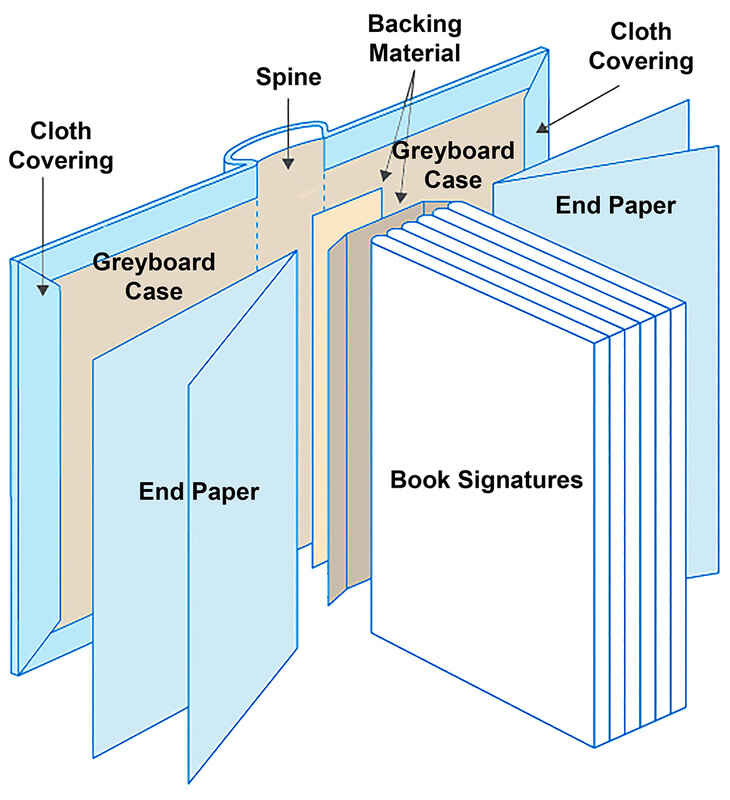
Case binding is a hardcover construction method in which the book block and the rigid cover case are produced separately, then joined during casing-in through the endpapers and supporting spine materials. The University of California, Berkeley Library Bindery defines a case as two boards plus a spine inlay covered with paper, cloth, leather, or another material; the completed case is attached to the text block later. That distinction matters because a hard cover is not one component. It is an assembled system. Berkeley’s binding terminology makes this separation explicit.
My blunt view is that “hardcover” is one of the most abused words in print buying. It describes an appearance, not a full engineering specification. Two books may both look casebound on a sales sample, yet one has sewn signatures, reinforced spine lining, correctly matched boards, and stable endpapers, while the other relies on a weak attachment hidden beneath an attractive printed case.
A finished hardcover book has two major assemblies: the book block and the case. The book block contains the printed pages and their attachment structure. The case contains the front board, back board, spine inlay, and covering material. Endpapers, spine linings, and adhesive connect the two assemblies.
That sounds simple. It is not.
The load path changes every time the reader opens the cover. Force moves from the board through the joint, across the pastedown, into the endpaper fold, and finally toward the first or last section of the book block. When any transition is too stiff, too weak, too narrow, or poorly bonded, the failure usually appears near the hinge rather than in the middle of the book.
This is why a serious custom book printing specification should identify more than trim size, page count, paper, and cover finish. It should also state the binding method, spine style, endpaper plan, board structure, cover material, and any functional requirement such as frequent opening, library use, children’s handling, or long-term shelf display.
The book block is the complete stack of printed pages before it is attached to the case. It may be built from folded signatures or from individual leaves, depending on imposition, page count, paper, and binding method.
A folded-signature book block can be sewn through the folds, adhesive-bound after gathering, or constructed through a hybrid process. A loose-leaf block may use double-fan adhesive binding or another adhesive method. The University of Illinois describes through-the-fold sewing as signatures sewn together with thread, often supported by cords or tapes, while adhesive structures secure leaves at the spine edge. Its preservation guide to books and bound items also notes that sewing supports can add stability to the text block.
The hard truth? A beautiful case cannot rescue a poorly planned book block.
Paper grain should run parallel to the spine wherever production allows. Cross-grain pages resist opening, create spring-back, and place extra stress on the first and last sections. Heavy coated paper, dense ink coverage, gatefolds, tip-ins, and very thick sections also change the mechanical behavior. These details belong in pre-production review, not in the complaint email after delivery. The Illinois inspection handbook specifically identifies stiff paper and paper running perpendicular to the spine as factors that can impair openability.
Leaf attachment is the method holding the pages together. It is separate from the case itself, yet it determines whether the book block can survive repeated opening.
Smyth sewing, also called section sewing or thread sewing, joins folded signatures through their folds. Adhesive binding joins leaves or prepared signature edges with adhesive. Double-fan adhesive binding exposes a small margin on both sides of each leaf so adhesive can penetrate the spine edge.
The University of Illinois Bindery Handbook defines double-fan adhesive binding as exposing no more than 1/16 inch of each leaf’s spine margin during fanning. Yale Library’s binding specification limited double-fan adhesive volumes to 2 inches in thickness and required polyvinyl acetate-based adhesive meeting its cited library-binding standard. These are institutional requirements, not universal commercial limits, but they show that “glued hardcover” is not a complete specification. Yale’s bookbinding RFQ treats attachment method, adhesive, thickness, trimming, and spine treatment as separate controls.
Is sewing always better? No. A badly sewn book with oversized sections, weak folds, excessive thread swell, or poor spine shaping can perform worse than a well-made adhesive case binding. But for books expected to receive frequent handling, wide opening, or long service, sewn signatures usually give the production team more structural options.
Endpapers sit at the front and back of the book block. Each endpaper assembly normally includes a pastedown, which is adhered to the inside board, and a flyleaf, which remains free.
They are not decoration.
The University of Illinois defines endsheets as pages added to protect the text block and secure it into the cover. In practice, they also conceal board edges and turn-ins, provide a clean transition from cover to content, and sometimes carry maps, patterns, branding, or publishing information. The Illinois Bindery Handbook separates the pastedown from the flyleaf because they perform different jobs.
Weak endpaper paper, poor grain direction, over-strong adhesive, insufficient reinforcement, or a bad fold position can produce familiar defects: bubbling on the pastedown, tearing at the hinge, board exposure, cockling, or the first page pulling away from the text block.
And here is an unpopular opinion: printed endpapers are often approved as artwork when they should first be approved as a structural material.
After the pages are attached, the spine may receive adhesive and one or more linings. Common materials include paper lining, woven cloth, gauze or mull, and other reinforcing substrates selected for the book’s weight and opening requirement.
The spine lining stabilizes the back of the text block and helps transfer load toward the case. In many constructions, a cloth lining extends beyond the spine to form flanges that support attachment near the boards or endpapers. A hollow-back case can include a paper tube or hollow that allows the case spine to move separately from the text-block spine.
The Illinois quality-control checklist asks whether spine lining is smooth, fully adhered, positioned within 1/2 inch of the head and tail, and extended at least 1 inch onto each board in the library construction it specifies. Those numbers should not be copied blindly into every commercial order, but they prove a larger point: lining width and placement are measurable production variables, not invisible factory trivia.
The front and back boards create rigidity, protect the book block, and establish the tactile weight of the finished book. Board selection affects squareness, warp resistance, corner durability, joint behavior, and the relationship between cover size and text-block size.
Greyboard is common in commercial case binding, while specialized archival, conservation, or library work may use other board types. Thickness must suit the trim size, book weight, spine shape, intended use, and covering material. A small gift book with oversized boards can feel clumsy. A large illustrated volume with under-specified boards can flex, bow, or show handling damage quickly.
Board caliper alone is not enough. Density, moisture balance, flatness, cutting accuracy, and compatibility with the cover stock all matter. When comparing hardcover production and finishing capabilities, buyers should ask how board material is selected and conditioned, not merely whether “2 mm board” is available.
The spine inlay is the strip positioned between the front and back boards inside the case. It creates the case spine and helps define whether the finished book has a square, rounded, flexible, or more rigid back.
It must be distinguished from the spine lining on the book block. The inlay belongs to the case. The lining belongs to the text-block assembly.
For a square-back hardcover, the inlay helps maintain a clean rectangular spine. For rounded-and-backed books, the case spine and any hollow structure must accommodate the shaped text block. A stiff inlay on a book that needs flexible opening can fight the book every time it is used.
The covering material wraps the boards and spine inlay. Common commercial options include printed paper, laminated printed paper, book cloth, coated cloth, synthetic covering materials, and combinations used for quarter-bound or three-piece cases.
Cover stock affects more than appearance. It must turn cleanly over board edges, fold at the joints without cracking, bond consistently, resist scuffing, and remain dimensionally balanced after adhesive application. Film lamination adds surface protection, but it can also change stiffness and curl behavior. Cloth accepts different stamping and gluing processes than coated paper.
Berkeley describes buckram as a strong cloth developed for hardbound library covers, while Yale’s specification distinguishes heavier Group F buckram from lighter C-1 cloth for volumes under 2 pounds. Again, this is library practice, not a rule for retail publishing, but it shows why “cloth cover” is far too broad for professional purchasing.
The joint is the exterior groove beside the spine. The hinge is the corresponding interior flexing area. The squares are the small board projections beyond the head, tail, and fore edge of the book block. Turn-ins are the portions of covering material folded around the board edges to the inside.
Tiny geometry. Big consequences.
If the joint is too tight, the cover resists opening and pulls aggressively on the endpaper. If it is too loose, the book can feel unstable and the spine may shift. Uneven squares make the entire book look misregistered even when the print is accurate. Poorly cut corners create exposed board tips or bulky folds.
The Illinois inspection guide checks whether joints run parallel to the spine, whether their depth is uniform, whether boards sit correctly against the shoulders, and whether turn-ins are even. That is the correct mindset: casebound quality is inspected as geometry, adhesion, and movement—not merely as color and finish.
Headbands and tailbands are the small decorative bands at the top and bottom of the spine. In many modern commercial hardcovers, they are pre-made decorative components rather than structural sewn endbands. Ribbon markers, pockets, tip-ins, elastic closures, belly bands, dust jackets, and slipcases are optional additions.
Do not confuse decoration with reinforcement. A headband can improve appearance and conceal the top of the spine gap, but it does not automatically strengthen the text block. A ribbon marker adds a concentrated element near the spine and must be placed without creating a lump. A pocket or foldout changes local thickness and may affect pressing.
Optional components should be designed into the construction from the beginning. Adding them after the case dimensions are fixed is how tolerances disappear.
| Component | Primary Function | Common Failure Signal | What the Buyer Should Specify |
|---|---|---|---|
| Book block | Holds the printed content as one unit | Pages spring closed, gutter is tight, sections shift | Page count, paper, grain direction, inserts, expected opening behavior |
| Leaf attachment | Secures leaves or signatures | Loose pages, cracked glue line, broken folds | Sewn, adhesive, double-fan, or approved hybrid method |
| Endpapers | Connect the book block to the case and protect end sections | Hinge tears, bubbling, first page pulls away | Plain or printed, paper type, color, reinforcement requirement |
| Spine adhesive | Consolidates the spine | Brittle cracking, excessive stiffness, adhesive squeeze-out | Adhesive family where performance requires it; sample testing |
| Spine lining | Reinforces the back and transfers opening load | Spine detaches, hollow collapses, uneven opening | Lining construction appropriate to book weight and use |
| Boards | Provide rigidity and protection | Warping, flexing, crushed corners | Board type, caliper, finished case size, squareness tolerance |
| Spine inlay | Forms the case spine | Spine dents, twists, or fights opening | Square or rounded spine, rigid or flexible behavior |
| Covering material | Wraps and protects the case | Joint cracking, delamination, scuffing, curl | Printed paper, lamination, cloth, stamping, grain and finish |
| Joints and hinges | Allow controlled cover movement | Cover will not open freely; endpapers split | Joint geometry approved through a bound dummy |
| Optional additions | Add function or visual value | Local bulges, pressure marks, inconsistent trimming | Exact position, thickness allowance, attachment method |
The table exposes a purchasing mistake I see repeatedly: buyers specify visible materials precisely and hidden structures vaguely. They may provide a Pantone reference for cloth and a foil code for stamping, yet leave the binding line as “hardcover binding.” That reverses the risk hierarchy.
Printed sheets are folded into signatures or organized as leaves. Signatures are gathered in sequence and checked for pagination, orientation, and completeness. Inserts, plates, foldouts, and tip-ins must be accounted for because they change thickness and balance.
The sections or leaves are attached by the selected method. Sewn books may be sewn through the fold. Adhesive structures may be milled, notched, roughened, fanned, or otherwise prepared according to the approved process.
The Library of Congress commercial binding statement allows notching for double-fan adhesive binding no deeper than 2 mm and limits milling removal to 2 mm in the specific preservation context it governs. It also applies a general no-trim policy unless instructed, with trimming capped at 3 mm for the materials described. The Library of Congress binding statement of work is unusually useful because it converts abstract quality language into measurable limits.
The block is trimmed where required, then the spine is glued, shaped, and lined. A square-back book remains flat at the spine. A rounded-and-backed book is shaped to create a rounded spine and shoulders that accommodate the boards.
Yale’s institutional specification exempted text blocks under 1/2 inch from rounding and backing and stated that sewn signatures thicker than 1/4 inch, or 6 mm, should be rounded only. Those limits are not a retail hardcover formula. They are evidence that spine treatment must respond to text-block geometry rather than marketing language.
Front and back boards and the spine inlay are positioned on the glued covering material. The covering material is turned over the edges, corners are formed, and the case is pressed or dried flat.
Spacing is decisive. The board-to-spine gap must create a joint that opens without tearing the covering material or overloading the endpaper. A fractional error repeated across a production run becomes a visible defect on every copy.
Adhesive is applied to the outer endpapers, and the book block is fitted into the completed case. Berkeley’s definition of casing-in is exactly that: applying adhesive to the outside endpapers and fitting the text block into its case.
Alignment must be controlled at the head, tail, fore edge, and spine. Once pastedowns make full contact, correction becomes difficult. A shifted block can create uneven squares, a twisted spine, or a cover that opens differently at the front and back.
The joint is formed, the book is pressed, and the adhesive is allowed to set under controlled conditions. Pressing must create contact without crushing the spine, embossing unwanted marks through the cover, or forcing adhesive into the text block.
Then comes inspection.
The University of Illinois handbook checks spine stamping, cover adhesion, joint alignment, spine shape, lining, endpapers, turn-ins, page security, and openability. I strongly agree with that order. Cosmetic review alone cannot certify a structurally sound casebound book.
The best evidence comes from organizations that expect books to be used, shelved, reopened, repaired, and preserved—not merely photographed on launch day.
In 2025, the Library of Congress marked 125 years of binding operations, an unusually long institutional record showing that binding decisions are part of collection management, not just finishing. Its retrospective reports that the binding operation was once expected to process as many as 100,000 books per year. The Library’s 2025 binding history also discusses changes in facilities, materials, and production expectations across decades.
The Library’s procurement statement placed a 64 mm, or 2½-inch, maximum thickness on the serial volumes covered by that contract. It also separated collation, leaf attachment, case-making, casing-in, quality review, tracking, and turnaround requirements. That is a real institutional case study in how professional buyers control binding risk: they do not purchase “a hardcover.” They purchase a defined process.
Yale’s binding RFQ treated the book as a controlled chain: leaf attachment, trimming, spine adhesive, rounding and backing, spine lining, covering material, boards, inlay, case assembly, corners, and casing-in. It even specified 18-point spine lettering, dropping to 14-point for books thinner than 1 inch, and required 600 dpi or higher for certain preservation replacement printing. This is not because librarians enjoy paperwork. It is because ambiguous specifications transfer risk to the finished object.
The University of Illinois inspection procedure goes further by checking whether turn-ins are approximately 5/8 inch, whether spine lining extends within 1/2 inch of the head and tail, and whether lining extends at least 1 inch onto each board in its prescribed structure. These are not numbers I would paste into every publishing contract. But I would copy the method: define what matters, measure it, and inspect it after binding.
A split near the hinge may come from weak endpaper stock, wrong grain direction, an overly tight joint, insufficient reinforcement, poor adhesive coverage, or a case that was fitted too tightly around the text block.
Replacing the endpaper with a heavier sheet may make the problem worse if stiffness rises without improving fold endurance. The correct fix begins with the full load path.
Warp can result from moisture imbalance, one-sided lamination, uneven adhesive application, incompatible covering and lining materials, rushed drying, or storage conditions after production.
Thicker board may resist some deformation, but it can also increase weight and hinge stress. “Use thicker board” is a comforting answer because it sounds concrete. It is not always the right answer.
Books that snap shut, expose too little gutter, or strain at the first and last pages often reflect a combination of paper grain, section thickness, spine stiffness, adhesive choice, joint geometry, and case fit.
No finishing trick can fully correct that after casing-in. A physical dummy made with production-equivalent paper is far more valuable than a flat cover proof.
Modern pre-made headbands can finish the top and bottom of a casebound spine neatly. They do not replace sound leaf attachment, spine adhesive, lining, or endpaper design.
This is worth saying because visual accessories are easy to sell. Structural restraint is harder.
Sewing is a method, not a guarantee. Thick signatures can create excessive swell. Sewing tension can distort folds. Weak paper can tear around stitches. Spine adhesive can be too rigid. Case dimensions can still be wrong.
A sewn label should earn attention, not automatic trust.
Start with the use case. Is the book a premium novel, art monograph, children’s title, yearbook, training manual, journal, corporate presentation, or limited edition? How often will it open? Must it lie reasonably flat? Will it include coated paper, tip-ins, pockets, ribbons, or a dust jacket?
Then specify the structure in plain language:
Before issuing a purchase order, review the printer’s company and production background, confirm which processes are performed or controlled through its stated capabilities, and request a dummy that uses the actual paper whenever opening behavior matters.
I would also ask four direct questions: What holds the pages together? What connects the book block to the case? What material reinforces the spine? And what tolerance will be inspected before shipment?
Those questions cut through sales language fast.
The main case binding components are the book block, leaf-attachment structure, endpapers, spine adhesive, spine linings, front and back boards, spine inlay, covering material, joints, hinges, squares, and turn-ins, with optional headbands, ribbon markers, jackets, pockets, or slipcases added for appearance or function.
Technically, the “case” itself is the boards, spine inlay, and covering material made separately from the book block. The other components complete the hardcover book construction and determine how the two main assemblies open, flex, and remain attached.
Case binding works by producing the printed book block and rigid cover case as separate assemblies, preparing and reinforcing the spine, applying adhesive to the outer endpapers, fitting the block into the case, forming the joints, pressing the book, and allowing the adhesive system to set before final inspection.
The exact process changes with sewn versus adhesive attachment, square versus rounded spine, paper type, page count, cover material, and added features. A production-equivalent dummy is the safest way to verify opening behavior.
The book block is the complete bound stack of printed pages, including its signatures or leaves, attachment method, spine adhesive, linings, and endpapers, while the case is the separately manufactured rigid cover made from two boards, a spine inlay, and the outer covering material.
They are joined during casing-in. Confusing these assemblies leads to weak specifications because “hardcover” describes the case appearance without stating how the pages are attached or reinforced.
Endpapers are folded sheets at the front and back of a casebound book that protect the first and last pages, provide the pasted surfaces that attach the book block to the boards, conceal internal cover construction, and help transfer opening forces between the rigid case and flexible text block.
Their paper strength, grain direction, fold durability, printing coverage, adhesive compatibility, and reinforcement method affect hinge life. Printed endpapers should therefore be reviewed as structural components as well as artwork.
Sewn case binding joins folded signatures with thread and usually offers strong page security and flexible structural options, but it is not automatically superior because section thickness, fold strength, sewing tension, thread swell, spine shaping, adhesive, lining, paper grain, and case fit can still produce a stiff or damaged book.
A well-engineered adhesive case binding may outperform a poorly executed sewn book. The correct choice depends on paper, format, use frequency, opening requirement, page count, and budget.
The best hardcover board thickness is the caliper that provides adequate rigidity, flatness, corner protection, and visual proportion for the book’s trim size, text-block weight, spine construction, covering material, and intended handling without making the cover unnecessarily heavy or placing excessive stress on the hinges.
There is no universal number. A bound dummy should confirm board feel, squares, opening resistance, and warp behavior before mass production, especially for large-format, coated-paper, or heavily finished books.
A complete case binding quote request should state trim size, page count, interior paper, printing colors, signature or leaf construction, attachment method, spine style, endpaper specification, board requirement, cover material, surface finishes, optional components, quantity, packaging needs, target destination, and any opening, durability, sampling, or inspection requirement.
Send artwork details and photographs of reference books only as supporting evidence, not as substitutes for construction data. To turn those choices into a production review, contact the book printing team with the intended use and required quantity.
Do not approve a casebound book from a cover rendering alone.
Ask for the construction. Ask what holds the pages, what reinforces the spine, how the endpapers are attached, how the board and joint dimensions are established, and which defects will trigger correction. Then request a physical dummy made with the intended paper and near-final thickness.
For a project-specific review, send your trim size, page count, paper choice, quantity, cover concept, and expected use through the JetPrint contact page. A useful quote should identify the structure behind the hardcover—not merely repeat the words “case binding.”

Leave Your Comments